Accessibility Menu
Skip to content
Für Patienten
Für Fachkreise
intervista-brand-research-compressed

Brandawareness,brandingandimageresearch

Brand research by intervista

Strong research for strong brands

A distinctive, attractive brand is a key success factor. It forms the basis for the relationship between the company and its customers. A strong brand condenses and conveys everything that makes a company or product special: its values, its unique strengths, its value proposition. It conveys not only information about the offer, but also emotions, sometimes a whole attitude to life. It gives customers orientation and security in their purchase decision and enables lasting customer loyalty.

However, exactly how the brand is positioned is only partly within the company’s control. The brand is shaped by all the company’s offers and activities, especially marketing and communication measures. But competitors' activities and social change also play a role. The brand is a result of these diverse influences: It is created and grows, but must be continuously nurtured and strengthened – because ultimately the only decisive factor is whether and how the brand is perceived by the target group. Brand research by intervista provides reliable insights into this.

We accompany you through all the steps of brand management: together with you, we develop new image concepts, measure and track the awareness and image of your brand in the competitive environment. We use innovative research designs and complex analyses to understand how your brand’s image is created and how you can optimise it.
Brand awareness and positioning over time

Brand Trackings

Strategic and operative brand management are among the most important tasks of corporate management. They succeed best when planning can be based on reliable figures and the success of activities is regularly monitored. That is why numerous companies rely on brand tracking by intervista.

In these studies, we collect central brand KPIs – depending on the client’s needs as an annual or quarterly wave study or even as daily monitoring.

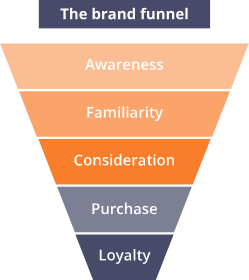
We collect the central brand KPIs along the brand funnel:

the brand funnel
check
Brand Awareness

A high degree of brand awareness is a basic prerequisite for a brand to have a great impact. Relevant KPIs for this are spontaneous brand recall and aided brand recognition. It is also interesting to know which brands are top of mind.

check
Brand Familiarity

Familiarity in name only is not enough. Potential customers must also have an idea of the products and services behind it. Knowledge about the brand is therefore also collected at this funnel stage.

check
Consideration

Which brands are considered, i.e. are in the relevant set for the respective product or service category? And which is the first choice? The findings on these questions provide information on how well your brand is actually positioned and which are the most threatening competitors.

check
Purchase/customer status (Purchase)

Of course, the actual purchase and usage behaviour must not be missing from a brand study. Which brands have you already used? Where are you currently a customer? These questions provide information about market conditions.

check
Loyalty

Loyal customers are those who remain loyal to the brand, buy repeatedly or remain a customer, desire it and are happy to recommend it to their friends. On the last funnel level, we collect KPIs on brand popularity, brand loyalty and willingness to recommend (NPS).

Innovative market research on brand image

Image measurements

How do your current customers and potential target groups see your company or brand? What characteristics are attributed to your brand? How does the image of your brand develop over time? Have communication measures improved the image of your brand? How does your brand compare to the competition?

The right image directly influences the attractiveness of your brand or your company. It helps to decide which target groups you address, how loyal your existing customers are and how successful you are in winning new customers.

We survey how your company or brand is perceived and create an individual image profile with various image dimensions. This allows us to identify differences between the current image (actual image) and the desired image (target image). On this basis, we develop practical suggestions for optimising and positioning your brand.

check

Consumers unconsciously learn much more about brands than they are aware of and can explicitly name. Unconscious, implicit knowledge can be decisive for a customer’s attitude towards a brand and thus for their buying and usage behaviour – especially in the case of products for which decisions tend to be made spontaneously or no detailed understanding of the product can be gained. In order to take these intuitive and automated decision-making processes into account, intervista uses innovative methods that involve measuring reaction times in the millisecond range. In this way, we validly determine how strongly your brand is mentally linked to various image dimensions.

check
Image tracking and benchmark measurements

Longer-term and regular image tracking allows you to keep an eye on the development of your image and, if necessary, to initiate targeted communication measures in good time. Simultaneous recording of the image values of your competitors enables you to interpret your own image profile in comparison with your competitors (benchmarking). We offer you comparative analyses of the strengths and weaknesses of your brand image and target-oriented recommendations for action to optimise your market positioning.

check
Explicit image measurement

The data collection can be done classically via image-related statements. The various drivers of the image are identified and their structure analysed in order to create a comprehensive and well-founded image profile of your brand.

Analysis and impact assessment of employer branding

How effective is your employer brand?

How effective is your employer brand?

In a competitive job market, a strong employer brand is crucial for successful recruitment and employee retention. Using empirically based methods, intervista makes the perception and impact of your employer brand measurable and provides actionable insights. Learn more about how to build a data-driven and effective employer brand.

About the method
Interview with Dr Michael Schrackmann

Brand tracking studies

Dr Michael Schrackmann is a member of the management team at intervista. Bettina Hufschmied, Marketing Manager at intervista, talks to him about, among other things, what to look for in brand tracking studies in terms of quality, what the trends are and why intervista tailors its studies to the needs of its clients.

To the interview
Brand tracking studies
Impact analysis of sponsorship

How does sponsorship work?

Wirkungsanalyse Sponsoring

Researching the interdependencies between marketing activities and brand image requires a lot of experience and methodological know-how. Read this detailed article to find out how we studied the effect of sponsorship on image, consideration and willingness to recommend.

Read article
Frequently asked questions

FAQs

Brand tracking is a regularly repeated brand study used to measure the development of key brand metrics (KPIs) over time. Typical metrics include unaided and aided brand awareness, brand image, consideration (whether the brand is considered in a purchase decision), brand preference, as well as purchase intent, usage, and willingness to recommend. This makes it possible to see how a brand’s perception and positioning are evolving, how it stacks up against the competition, and whether communication or marketing initiatives are driving changes in brand metrics.

To ensure a meaningful comparison, the most important competitors are directly included in the study. Awareness, image, and other brand metrics are measured using the same questions within the same target group. This creates benchmarks that show where a brand stands in the competitive landscape, what strengths set it apart, and where there is room for improvement. Repeated measurements also reveal whether it is only your own brand that is changing or whether a trend is affecting the entire market.

Brands are not perceived solely through conscious and deliberate thought, and people do not make decisions based exclusively on conscious considerations. Spontaneous impressions and automatically triggered associations can also influence the perception and evaluation of a brand. intervista’s implicit image measurement captures these spontaneous evaluations: Respondents decide as quickly as possible whether attributes such as “modern” or “trustworthy” fit a brand. In addition to the response itself, reaction time is also taken into account. It provides insight into how strongly a brand is mentally linked to certain attributes. This reveals which brand values are intuitively embedded and how your brand differs from competitors.

The appropriate frequency depends on the study’s objectives, market dynamics, and the brand’s communication activities. To monitor long-term trends in brand values or brand image, an annual measurement is generally sufficient. For major brands with high communication intensity or in highly dynamic markets, quarterly, monthly, or continuous brand tracking surveys are more appropriate. This also allows for the observation of shorter-term changes, such as those occurring during a campaign. Regularly collected time series can also serve as a valuable basis for marketing mix modeling: they make it possible to correlate the development of brand metrics with advertising activities, marketing expenditures, and sales data.

Reliable brand tracking requires measurement conditions that are as comparable as possible. This includes consistent question wording and response scales, a stable target group definition, and comparable sampling methods and structures. Seasonal effects and changes in the market environment should also be taken into account. Not every fluctuation indicates an actual change in brand perception. Differences should therefore be assessed while taking into account the sample size and statistical uncertainty. Tracking trends over multiple measurement points and comparing results with competitors help to better contextualize individual fluctuations.

The required sample size depends on how precisely results are to be reported and which subgroups are being compared. A general overview requires fewer interviews than detailed analyses by region, age group, customer segment, or other target groups. The expected changes between measurement points also play a role: the smaller the differences that need to be reliably detected, the larger the sample size generally must be. Therefore, the sample size should be determined based on the analysis objectives and the desired statistical precision.

However, sample size alone is not the sole determinant of representativeness. Equally important are the sampling method and the composition of the sample: It should reflect the relevant target group as closely as possible in terms of key structural characteristics.

A high-quality online panel forms the basis for representing the relevant population or target group as reliably as possible. Controlled recruitment, careful sampling, and ongoing quality checks are crucial for this. A large panel offers the advantage that new samples can be drawn across multiple survey waves, and participants from earlier waves can be excluded for a defined period. Such a “fresh sample” reduces learning and recall effects caused by repeated surveys on the same topic. intervista uses its own online panel and consistent sample management over time to achieve this.

Yes, through the intervista B2B Online Panel, professional target groups can be surveyed specifically based on characteristics such as job function, industry, company size, or area of responsibility. For example, an insurance company can examine how it is perceived by individuals involved in insurance decisions at SMEs and how it is positioned compared to competitors. It is crucial to include individuals who are involved in the relevant decisions. Which target groups, sample sizes, and survey intervals are feasible depends on the size and accessibility of the respective group of people.

Industries, target groups and brand strategies differ. An insurance company, for example, faces different questions than a retailer. Even within a single industry, brands pursue different positioning strategies and have defined their own value propositions and brand values. That is why intervista tailors the key metrics, image dimensions, and benchmark brands to the specific research question. This also allows for the targeted evaluation of brand values defined internally by the company. Sample size and survey frequency are also selected appropriately. Existing question wording and scales can be incorporated if comparability with previous studies is to be maintained.

Felix Bernet
Felix Bernet

We’re happy to advise you!

Feel free to give me a call or send me an email. I look forward to hearing from you and discussing your research needs.